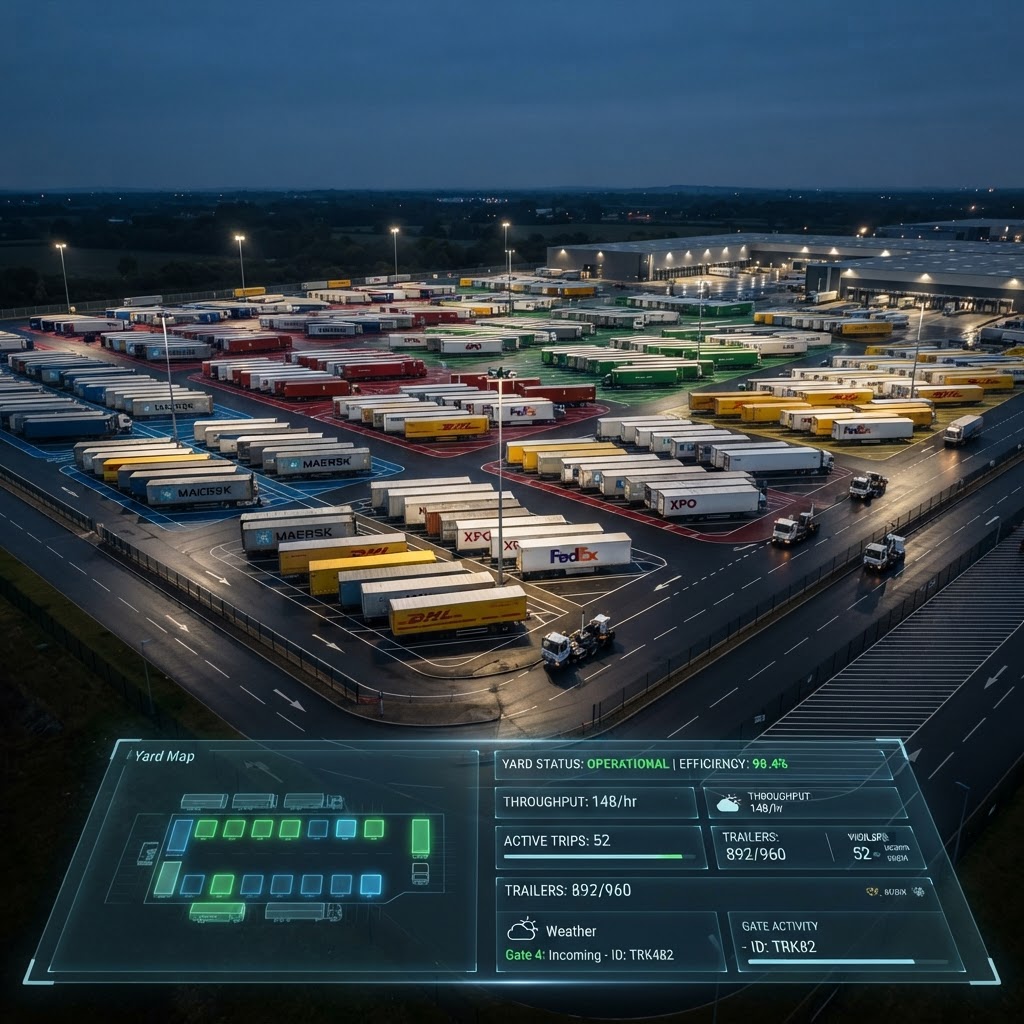
The 2026 Pivot: Why the Yard is No Longer a Support Function
For decades, the trailer yard was viewed as a transient storage area—a place where assets waited for a dock door. That era is over. As Bart De Muynck highlights in his analysis of 2026 supply chain trends, the yard has matured into a critical control point for flow, labor efficiency, safety, and asset utilization. It is no longer a peripheral support function; it is the primary valve that regulates the speed of your entire distribution network.
Organizations that treat the yard as a reactive holding pen suffer from chronic bottlenecks. When the yard loses visibility, the warehouse suffers from idle labor, and your carriers suffer from unpredictable service times. Strategic yard management requires viewing the facility as an active, intelligent buffer that balances incoming freight velocity with outbound shipping commitments.
The Cost of the Black Hole: Quantifying Inefficient Yard Operations
When a facility lacks real-time yard visibility, it operates in a data vacuum. This "black hole" effect creates three measurable drains on your bottom line:
- Detention and Demurrage: Without precise data on when a trailer enters, departs, and is spotted, you are susceptible to carrier-imposed penalties. Industry benchmarks suggest that avoidable detention costs often account for 5% to 10% of total transportation spend.
- Labor Idle Time: Warehouse supervisors often report that as much as 20% of their labor downtime is caused by the wrong trailer being spotted at the wrong door, or the inability to locate a high-priority shipment within the yard.
- Safety and Compliance: Manual gate checks and disorganized yard traffic increase the probability of trailer-to-pedestrian incidents. A chaotic yard is a high-liability environment.
The Control Point Framework: Flow, Labor, and Safety
Transitioning to a strategic model requires three pillars of operational discipline.
- Flow: Treating the yard as a dynamic queue rather than static storage. This means sequencing arrivals based on warehouse labor capacity and product demand, not just first-come, first-served arrivals.
- Labor: Automating the assignment of spotting tasks. When a driver enters the gate, the system should automatically identify the trailer, its priority status, and the optimal destination, dispatching the yard jockey directly to the task.
- Safety: Removing human error from the data capture process. Automation provides a definitive audit trail for gate activity, reducing the frequency of personnel wandering the yard to find misplaced equipment.
Eliminating Dwell: How Visibility Directs Labor Performance
Reducing trailer dwell time is less about equipment and more about information symmetry. When your yard management system shares data with your warehouse management system (WMS), the warehouse gains the ability to prepare for incoming freight before it even reaches the dock door.
Strategic yard management uses real-time visibility to minimize the time between 'trailer empty' and 'trailer departure.' By tracking events like 'gate in,' 'dock arrival,' 'loading complete,' and 'gate out,' you create a performance feedback loop. This data allows you to hold carriers and your own spotting crews accountable to specific service level agreements.
From Manual Gate to Automated Intelligence
Manual gate operations are the primary source of 'data latency' in the supply chain. Paper manifests and manual check-ins lead to errors that compound as the day progresses. Automated gate systems, integrated directly into your operating software, provide instant recognition and validation of arriving assets. This speed at the gate translates to less congestion in the approach lanes and more controlled, predictable traffic flow throughout the yard.
YardX Command: The Operating System for the Strategic Yard
Transforming the yard from a cost center to a strategic control point requires an execution layer designed for real-time intelligence. YardX Command serves as this backbone, integrating gate activity, trailer visibility, and spotting workflows into a unified view. By providing real-time data on trailer locations, dwell times, and task assignments, YardX Command enables managers to move from fighting fires to optimizing flow. Whether you are managing complex heavy-haul yards or high-velocity distribution centers, the system translates raw yard data into actionable tasks that directly reduce costs and improve throughput. Request a YardX Command demo to eliminate your yard's blind spots.
Related Reading
-
The Autonomous Node: Synchronizing Yard and Warehouse Ope...
-
The Unified Facility: How AI-Native Orchestration Syncs Y...
-
The 2026 Guide to Freight Factoring Automation: Solving t...
-
The 2026 Guide to Freight Factoring Automation: Surviving...
-
The 4PL Orchestration Playbook: Building a Tech-First Lea...
-
The 4PL Orchestration Playbook: Scaling a Tech-First Lead...
-
The 2026 Warehouse & Yard Orchestration Playbook: Bridgin...
-
The 2026 Warehouse & Yard Orchestration Playbook: Integra...
-
The 2026 Guide to Warehouse-to-Yard Orchestration: Solvin...
-
The 2026 Warehouse-to-Yard Orchestration Guide: Eliminati...
-
The 2026 Guide to AI-Native Warehouse Orchestration: Movi...
-
The 2026 Guide to AI-Native Warehouse Orchestration: Beyo...
-
The Autonomous Warehouse: Orchestrating Labor and Velocit...
-
The Autonomous Warehouse: How Agentic AI Orchestrates Lab...
-
The 2026 Shipper Retention Playbook: Transforming Portals...
-
The Shipper Retention Strategy: Why a White-Label Client ...
-
The Dock-to-Stock Velocity Blueprint: Closing the Yard Ga...
-
The 2026 Dock-to-Stock Velocity Blueprint: Bridging the G...
-
The 2026 Guide to Integrated Yard and Warehouse Intellige...
-
The 2026 Guide to Integrated Yard and Warehouse Intellige...
-
Combating the 2026 Cargo Theft Crisis: A Guide to AI-Nati...
-
The 2026 Cargo Theft Crisis: Why AI-Native Identity Verif...
-
The 2026 Warehouse Efficiency Audit: Eliminating 30% Labo...
-
The 2026 Warehouse Efficiency Audit: Eliminating Labor Wa...
-
The 2026 Guide to AI-Native Warehousing: Orchestrating WM...
-
The 2026 Guide to AI-Native Warehousing: Orchestrating WM...
-
The 2026 High-Velocity 3PL Playbook: Transitioning to an ...
-
The 2026 Warehouse Modernization Playbook: Implementing A...
-
The Unified Facility Blueprint: Synchronizing Yard and Wa...
-
The Unified Facility Blueprint: Eliminating Dock Bottlene...
-
The 2026 Unified Fulfillment Center: Eliminating the Logi...
-
The 2026 Unified Fulfillment Center: Why WMS and YMS Conv...
-
The Automated Cash Flow Engine: Mastering Brokerage Liqui...
-
Building a Liquidity Engine: Integrating Automated Factor...
-
Beyond Storage: The Operations Director’s Guide to Increa...
-
Beyond Storage: Maximizing Warehouse Throughput with an A...
-
The Unified Distribution Node: Closing the 'Black Hole' B...
-
The Unified Distribution Node: Architecting WMS and YMS f...
-
Beyond Manual Cycles: How AI-Native WMS Eliminates Invent...
-
The Autonomous Warehouse: Eliminating Inventory Drift wit...
-
The Frictionless Warehouse: Orchestrating Inventory, Dock...
-
The Frictionless Warehouse: Orchestrating Inventory, Dock...
-
The Frictionless Dock: Synchronizing WMS and YMS for Real...
-
Automating Freight Cash Flow: A Guide to Integrated Facto...
Frequently Asked Questions
Why is the trailer yard considered a critical control point?
The yard acts as the primary valve for your distribution network. When managed strategically, it regulates the speed of inbound and outbound freight, preventing bottlenecks that impact warehouse labor and carrier service levels.
How can yard automation reduce operational costs?
Automation eliminates manual data entry and human error at the gate. By providing real-time visibility, it reduces avoidable detention fees, minimizes warehouse labor idle time, and improves overall safety by tracking equipment movement.
What is the impact of yard visibility on warehouse labor?
Real-time yard visibility allows the warehouse to prepare for incoming freight before it reaches the dock. This synchronizes yard spotting with labor availability, ensuring the right trailers are at the right doors when staff is ready.
How does YardX Command integrate with existing warehouse operations?
YardX Command integrates directly with your warehouse management systems to create a performance feedback loop. It tracks gate activity, dock arrivals, and loading completion to ensure your yard operates as a dynamic, intelligent buffer.


