On This Page
- The 37-Day Reality: Why Traditional Cash Flow Stalls Growth
- What is Automated Freight Factoring?
- Recourse vs. Non-Recourse: Comparison of Financial Risk
- The Anatomy of an Automated Funding Cycle
- Eliminating Manual Friction Through Integration
- Legal Safeguards: UCC Filings and NOA
- Strategic Liquidity and Executive Intelligence
- Frequently Asked Questions (FAQ)
- Conclusion
- Related Reading
The 37-Day Reality: Why Traditional Cash Flow Stalls Growth
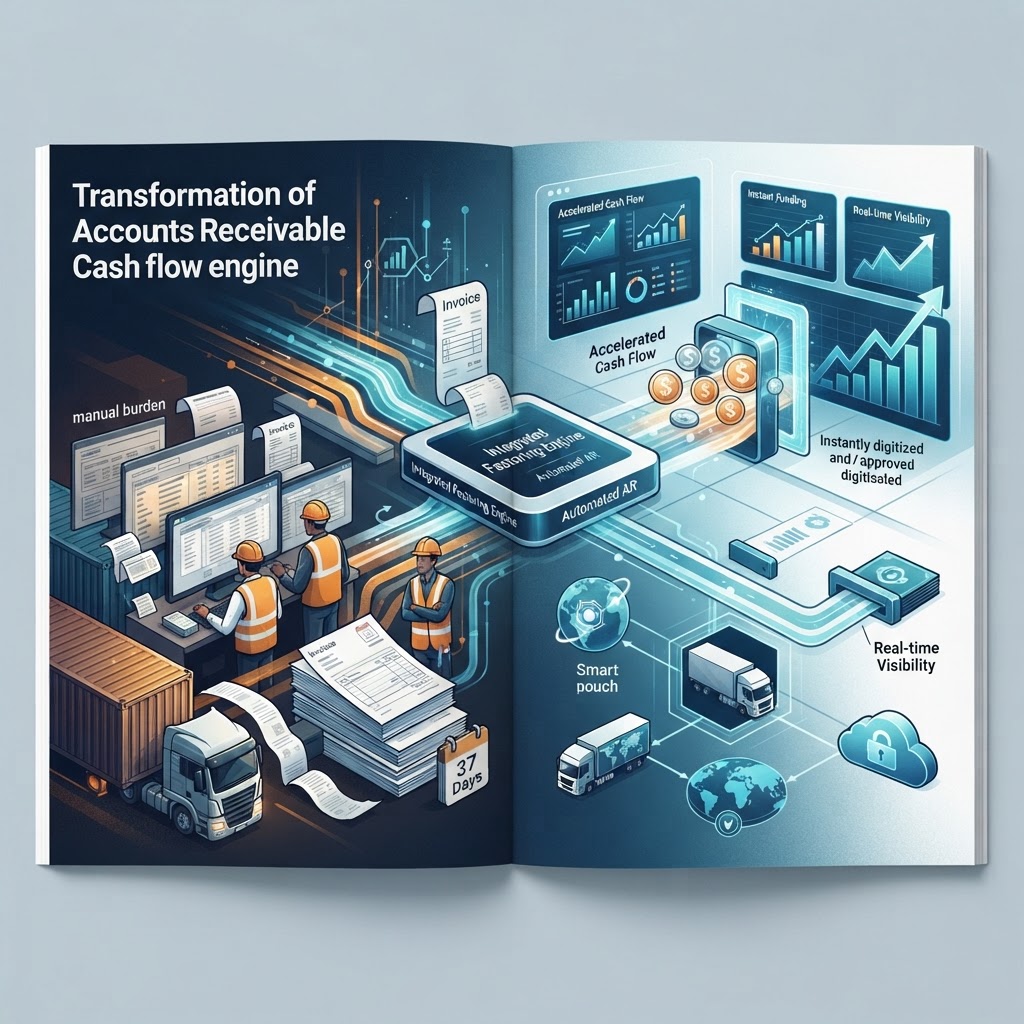
The logistics industry operates at a persistent financial disadvantage. Data from the 2024 State of Freight Report (see Table 4.2: Payment Terms and Collection Cycles, p. 28) indicates that the average Days Sales Outstanding (DSO) for carriers and brokerages hovers around 37 days. For operators, this gap between delivery and payment is a primary driver of stagnation. When capital remains tied up in accounts receivable, you lose the ability to reinvest in drivers, equipment, or essential technology.
Traditional factoring has long served as a patch for this liquidity gap. However, manual workflows—faxing paperwork, double-entry data in your Transportation Management System, and waiting for third-party verification—create layers of administrative friction. When your technology stack is fragmented, these manual processes lead to billing errors and delayed funding, directly eroding your margins.
What is Automated Freight Factoring?
Automated freight factoring integrates accounts receivable workflows directly into your operating platform. Rather than treating factoring as a separate financial transaction, it becomes a seamless component of your AI Business System. Upon delivery, proof of delivery (POD) capture triggers automated document validation, invoice generation, and submission to the factoring partner. This eliminates manual reconciliation and ensures cash flow aligns with operational output.
Recourse vs. Non-Recourse: Comparison of Financial Risk
Choosing between recourse and non-recourse models depends on your tolerance for credit risk versus your appetite for fee structures.
| Feature | Recourse Factoring | Non-Recourse Factoring | | :--- | :--- | :--- | | Primary Benefit | Lower upfront fees | Protection against shipper insolvency | | Risk Allocation | Carrier assumes risk of non-payment | Factor assumes risk of credit default | | Cost | Generally lower | Generally higher | | Use Case | High-volume, reliable shippers | Unknown shippers or volatile markets |
DirectX Factoring OS: Granular Recourse Reconciliation
DirectX Factoring OS manages the complexities of recourse models through an automated "Reconciliation Ledger." When a shipper fails to pay within the agreed term, the system automatically tags the invoice as a "Recourse Event." It then presents a clear dashboard view to the back-office, enabling one-click selection to either initiate a formal collection request, issue a credit memo to the debtor, or execute an automated charge-back to the carrier’s operating account. This granular visibility prevents bad-debt surprises by providing real-time aging reports specifically for recourse-flagged loads.
The Anatomy of an Automated Funding Cycle
Efficiency in funding depends on replacing manual touchpoints with digital triggers. The following cycle occurs within the DirectX ecosystem the moment a driver uploads a POD via the mobile driver interface.
- Document Capture: The driver uses the mobile interface, which features a high-contrast, guided "frame-and-capture" UI. It utilizes real-time image edge-detection to ensure the BOL or POD is clear and legible before the driver hits "Submit."
- AI Validation: The system scans for critical data points, including dates, signatures, and legible bill-of-lading numbers.
- Automated Submission: DirectX Factoring OS triggers invoice generation and API submission to the factor.
- Funding Disbursement: Approved capital is transmitted to your account, typically within 24 hours.
Eliminating Manual Friction Through Integration
Fragmented tech stacks are the primary threat to profitability. When your TMS operates in a silo from your financial systems, your team performs redundant data entry, which is inherently error-prone. By consolidating operations, you avoid the Margin Drain of Fragmented Tech Stacks. Integration ensures that factoring fees are calculated at the time of booking, providing clear visibility into the real profit of a load after financing costs.
Legal Safeguards: UCC Filings and NOA
Securing your financial interests requires rigorous adherence to legal protocols. A Notice of Assignment (NOA) informs the shipper that payment must be directed to the factor. According to the National Association of Credit Management, failure to properly manage UCC filings creates funding delays as financiers verify priority of interests. Modern automated systems manage these filings and notifications within the workflow, ensuring compliance without requiring staff to perform manual legal tracking.
Strategic Liquidity and Executive Intelligence
Financial visibility is the difference between survival and scaling. While factoring provides capital, tools like the DirectX Command Center provide context. By viewing factoring data alongside operational KPIs, you can forecast cash requirements based on upcoming delivery schedules rather than reacting to yesterday’s bank balance.
Frequently Asked Questions (FAQ)
How fast is freight factoring with an automated system? When integrated with a platform like DirectX, the validation and submission process happens in near real-time. Once the factor receives the API-submitted documents, funding is typically completed within 24 hours.
Does automation eliminate the need for manual invoice review? AI-powered validation acts as the first line of defense, checking for signatures and mandatory fields. This reduces the need for manual review to only those documents that fail automated verification.
How does integration affect my bottom line? Integration reduces administrative labor hours and prevents "hidden" costs like double-entry errors. It also provides accurate, real-time insight into the true profit margin per load after factoring fees are factored in.
Conclusion
Automation is about building a scalable foundation. By integrating factoring into your operating platform, you reclaim hours lost to administration and gain the visibility required for informed decision-making. Explore DirectX Factoring OS to automate your cash flow.
Related Reading
-
The Autonomous Node: Synchronizing Yard and Warehouse Ope...
-
The Unified Facility: How AI-Native Orchestration Syncs Y...
-
The 2026 Guide to Freight Factoring Automation: Solving t...
-
The 2026 Guide to Freight Factoring Automation: Surviving...
-
The 4PL Orchestration Playbook: Building a Tech-First Lea...
-
The 4PL Orchestration Playbook: Scaling a Tech-First Lead...
-
The 2026 Trucking Startup Financial Stack: Integrating Fa...
-
Building Your 2026 Trucking Startup Financial Stack: A Gu...
-
The 2026 Warehouse & Yard Orchestration Playbook: Bridgin...
-
The 2026 Warehouse & Yard Orchestration Playbook: Integra...
-
The 2026 Guide to Warehouse-to-Yard Orchestration: Solvin...
-
The 2026 Warehouse-to-Yard Orchestration Guide: Eliminati...
-
The 2026 Guide to AI-Native Warehouse Orchestration: Movi...
-
The 2026 Guide to AI-Native Warehouse Orchestration: Beyo...
-
The Autonomous Warehouse: Orchestrating Labor and Velocit...
-
The Autonomous Warehouse: How Agentic AI Orchestrates Lab...
-
The 2026 Shipper Retention Playbook: Transforming Portals...
-
The Shipper Retention Strategy: Why a White-Label Client ...
-
Surviving the 2026 Double Brokering Crisis: Protecting Ca...
-
The Dock-to-Stock Velocity Blueprint: Closing the Yard Ga...
-
The 2026 Dock-to-Stock Velocity Blueprint: Bridging the G...
-
The 2026 Guide to Freight Factoring Automation: Accelerat...
-
The 2026 Guide to Freight Factoring Automation: Accelerat...
-
The 2026 Carrier Cash Flow Manual: Mastering Automated Se...
-
The 2026 Carrier Cash Flow Manual: Automating Factoring a...
-
Eliminating the 30-Day Pay Gap: The Carrier's Guide to In...
-
Solving the 30-Day Pay Gap: A Guide to Integrated Freight...
-
The 2026 Carrier Liquidity Playbook: Eliminating Cash Flo...
-
The 2026 Freight Liquidity Playbook: Solving Net-90 Terms...
-
The 2026 Guide to Integrated Yard and Warehouse Intellige...
-
The 2026 Guide to Integrated Yard and Warehouse Intellige...
-
Combating the 2026 Cargo Theft Crisis: A Guide to AI-Nati...
-
The 2026 Cargo Theft Crisis: Why AI-Native Identity Verif...
-
The 2026 Warehouse Efficiency Audit: Eliminating 30% Labo...
-
The 2026 Warehouse Efficiency Audit: Eliminating Labor Wa...
-
The 2026 Guide to AI-Native Warehousing: Orchestrating WM...
-
The 2026 Guide to AI-Native Warehousing: Orchestrating WM...
-
The 2026 Freight Factoring Playbook: Navigating High Cost...
-
The 2026 High-Velocity 3PL Playbook: Transitioning to an ...
-
The 2026 Warehouse Modernization Playbook: Implementing A...
-
The Unified Facility Blueprint: Synchronizing Yard and Wa...
-
The Unified Facility Blueprint: Eliminating Dock Bottlene...
-
The 2026 Unified Fulfillment Center: Eliminating the Logi...
-
The 2026 Unified Fulfillment Center: Why WMS and YMS Conv...
-
The Automated Cash Flow Engine: Mastering Brokerage Liqui...
-
Building a Liquidity Engine: Integrating Automated Factor...
-
Beyond Storage: The Operations Director’s Guide to Increa...
-
Beyond Storage: Maximizing Warehouse Throughput with an A...
-
The End of the 30-Day Wait: Automating Cash Flow for Carr...
-
The Seamless Settlement: How Integrated Factoring OS Elim...
-
Beyond Net-30: How Integrated Factoring OS Automates Truc...
-
The Unified Distribution Node: Closing the 'Black Hole' B...
-
The Unified Distribution Node: Architecting WMS and YMS f...
-
Beyond Manual Cycles: How AI-Native WMS Eliminates Invent...
-
The Autonomous Warehouse: Eliminating Inventory Drift wit...
-
The 2026 Freight Factoring Playbook: Automating Liquidity...
-
The 2026 Integrated Factoring Playbook: Automating Cash F...
-
The 2026 Freight Fraud Defense Handbook: Protecting Margi...
-
The 2026 Freight Fraud Defense Handbook: Protecting Margi...
-
The Liquidity Engine: Why Integrated Factoring is the 202...
-
The Liquidity Engine: Why Integrated Factoring is the 202...
-
The Logistics Cash Flow Playbook: Scaling Mid-Sized Carri...
-
The Frictionless Warehouse: Orchestrating Inventory, Dock...
-
The Frictionless Warehouse: Orchestrating Inventory, Dock...
-
The Liquidity Engine: Why Integrated Factoring is the Hea...
-
The Liquidity Engine: Why Integrated Factoring is the Hea...
-
The Modern Freight Factoring Guide: Turning Accounts Rece...
-
The Frictionless Dock: Synchronizing WMS and YMS for Real...
-
Real-Time Freight Visibility: A Strategic Guide to Elimin...
-
3PL vs 4PL: Understanding the Difference and Choosing the...
-
Warehouse Management Systems: A Complete Guide for Distri...
-
The AI Business System: Building a Unified Operating Laye...
-
The Yard Control Point: Turning Gate and Trailer Data int...
Frequently Asked Questions
How does automated freight factoring differ from traditional factoring?
Traditional factoring often requires manual document submission and data entry. Automated freight factoring integrates directly with your TMS, triggering invoice generation and submission the moment proof of delivery is captured.
What is the primary benefit of integrating factoring into a TMS?
Integration eliminates manual administrative friction and redundant data entry, resulting in faster funding cycles and improved accuracy in your accounts receivable reporting.
How does the DirectX Factoring OS handle recourse events?
DirectX Factoring OS uses an automated Reconciliation Ledger to track recourse events, providing a dashboard for one-click collection requests, credit memos, or automated charge-backs.
Can automated factoring work with both recourse and non-recourse models?
Yes. Modern automated systems are designed to support both models, allowing operators to select the financial risk profile that best fits their specific shippers and cash flow requirements.


